

Qrp MCP ServerVerifiedFeatured
@StanimirTenev
Basic information
About Qrp MCP Server
Find quantum-vulnerable cryptography in your codebase — secp256k1, Ed25519, BLS, Schnorr, RSA. Local, offline MCP server for AI agents.
Qrp MCP Server config
Add this server to your MCP-compatible client using the configuration below.
{
  "mcpServers": {
    "qrp": {
      "command": "uvx",
      "args": [
        "qrp-mcp"
      ]
    }
  }
}
Qrp MCP Server tools
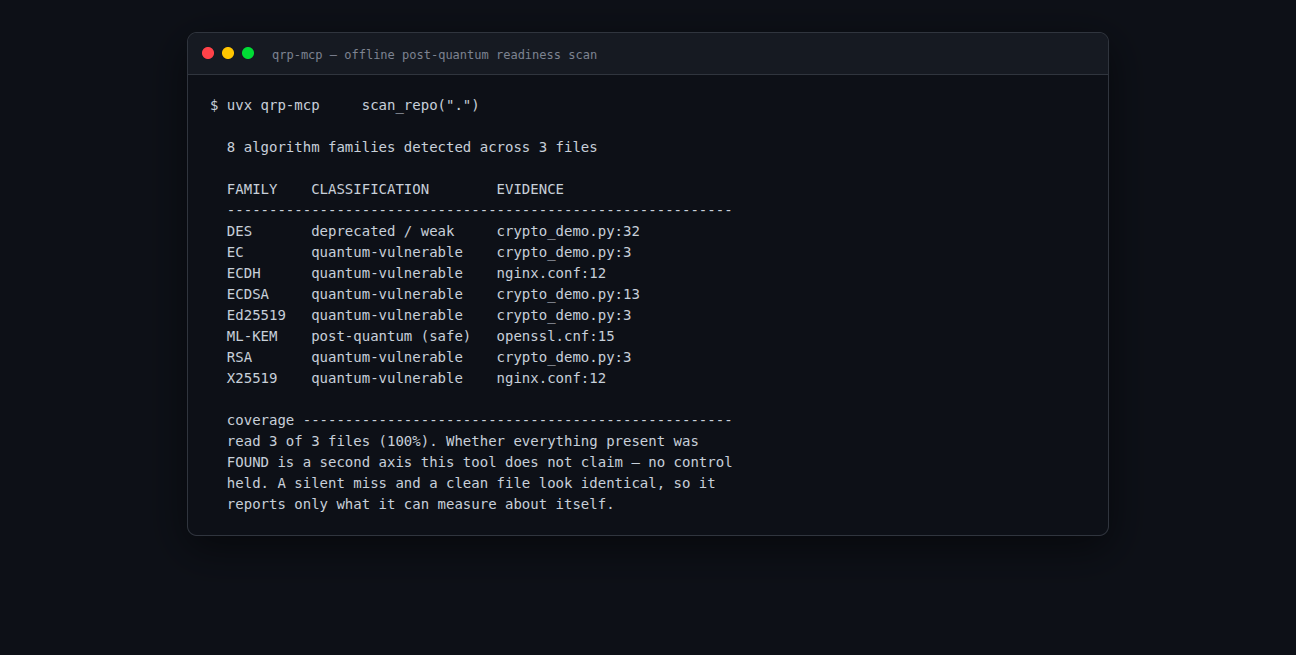
6Inventory the cryptography inside one local directory tree, file by file. Reads source, configuration (nginx.conf, sshd_config, .ini, .toml), CI pipelines, Terraform and Kubernetes manifests under `path`. Returns each algorithm found with its file and line, the mathematical family and standing of every post-quantum scheme, and a coverage count. Use this to answer what a specific project on this machine actually uses. Do not use it to ask whether this server knows a given algorithm, or to explain how one is classified without scanning anything -- `list_algorithms` answers that from the same table and reads no files. It is also the wrong tool for a network endpoint, a running host or a certificate store: it opens files on disk and nothing else. Coverage is reported as a fraction with a base. `files_scanned + unreadable_files + files_skipped_by_type + the linked files in symlinks_not_followed == files_present`; a link is not followed and is named, not read. A file that could not be opened is listed, never counted as scanned, because no findings in a file nobody read is not the same as a file that is clean. Files skipped because this tool does not claim their type are counted by extension, so the reader can judge the boundary rather than assume past it. The owner's own settings apply and are reported, never silent: a `.qrp.toml` at the root (its excludes are listed under `coverage.not_examined` as `excluded_by_config`; its baseline marks rows new or baselined), and `qrp:ignore <family> <reason>` comments, whose rows move to `suppressed` with the reason and are counted in `coverage.suppressed`; a marker past its `until=YYYY-MM-DD` no longer applies and is listed as expired. Cost scales with the size of the tree, so a large monorepo takes proportionally longer; there is no cache and no partial mode. Quoted lines are masked by default. Reading happens on this machine, but this result does not stay on it: it is returned to a model, which is a place the scanned line has not been before. A secret sharing a line with a finding -- a token in the call that names the cipher -- would travel with it. Masking keeps what a reader needs (the algorithm, the file, the line number, the shape of the call) and removes what nobody asked for. Pass `level="full"` when the line itself is the thing being examined.
List every algorithm family this server can recognise, and how each is classified. Returns the whole table: family name, classification (classical and quantum-vulnerable, post-quantum, symmetric, hash, or deprecated) and the kind of use it stands for. Reads no files and takes no arguments. Use this to check coverage before trusting a scan -- whether a scheme the project depends on is one this server knows at all -- or to explain a classification without scanning. To find what a particular directory uses, use `scan_repo` instead; this tool never looks at a codebase. An algorithm absent from this table is reported as `unknown` by a scan, which is not the same as absent from the code.
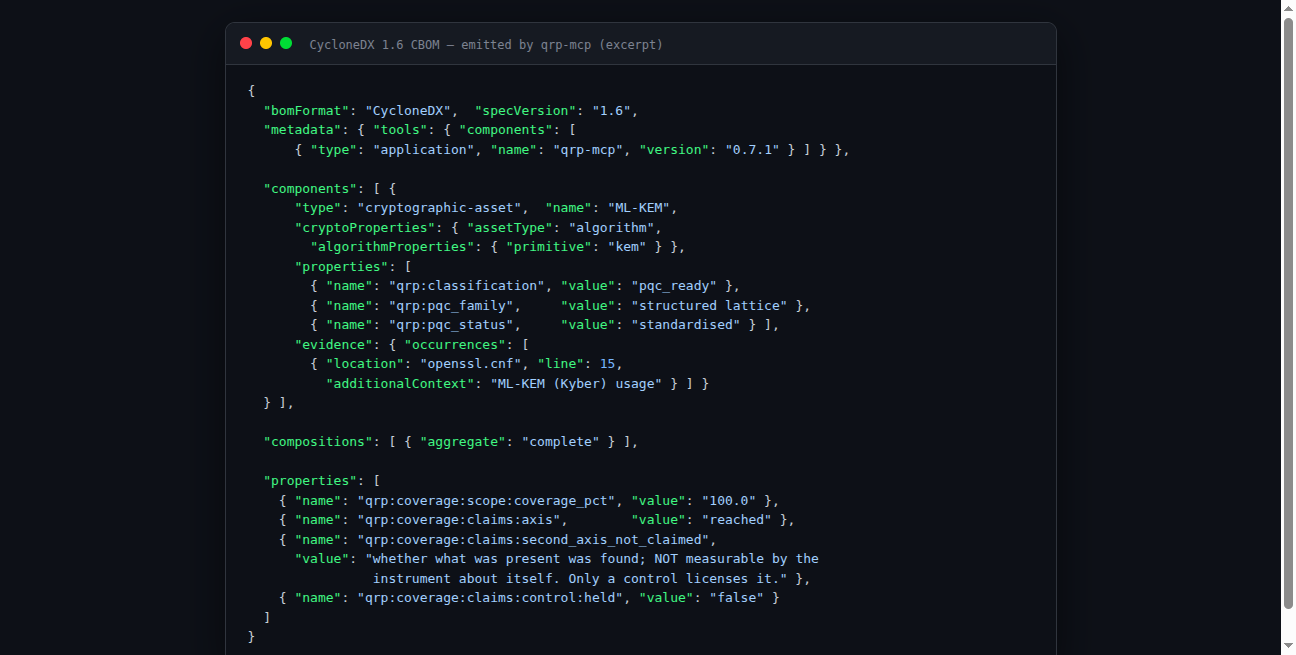
Scan one directory and return a CycloneDX 1.6 CBOM that carries its own coverage. Same reading as `scan_repo`; a different document. Use this when the result has to leave the machine -- an auditor, a customer, a pipeline artefact -- and `scan_repo` when a person or an agent is going to read it here. What the document carries beyond the components: `compositions.aggregate` states how complete the list is in the schema's own vocabulary, `complete` only when every file present was examined; `properties` carries the whole coverage block flattened, including every file not examined with its reason; and each asset carries `evidence.occurrences` with file, line and matched text. The coverage block travels as `properties` because the CycloneDX root object is `additionalProperties: false` and the format has no field for it. That is the point of emitting it this way rather than a limitation to work around. The serial number is derived from the two pins and a digest of the findings, not from where the tree sits, so two runs of the same code over the same corpus that find the same things share it and a different result does not. The timestamp is the tree's commit time (or SOURCE_DATE_EPOCH), so two runs over one unchanged tree give the same bytes; the read window stays in the scan result. The matched text in `evidence.occurrences` is masked by default, for the reason given on `scan_repo` and one more: this document is the one built to be sent. An auditor needs the algorithm, the file and the line; the contents of the line are not part of the claim being made.
Say whether two scans produced numbers that can be compared at all. Two coverage percentages can differ because the estate moved, because the instrument moved, or because the corpus was collected differently, and the percentages show none of the three. This reads the pins and conditions in both blocks and answers with one of three verdicts. `comparable` means nothing that moves the number differs. `not_comparable` lists which conditions differ, each with what it means, so the reader knows whether to re-run, re-clone or ignore it. `unestablished` means the blocks do not carry enough to decide -- an unpinned corpus, or an emitter that names no commit -- which is a different situation from a known difference and has a different repair. Use it before putting two coverage figures in one table. Do not use it to compare findings; it reads conditions, not results.
Say which findings a change actually closed, by comparing two saved scans of one tree. First it decides whether the two runs can be compared for closure at all: the same instrument commit, version, rules, file types and exclusions, both trees pinned to a commit and clean, both results quoting lines at the same level. The trees themselves may differ -- that difference is what is measured. If the runs cannot be compared, nothing is reported as closed and the repair is named. Only then does it match every occurrence without its line number: `closed` (present before, absent from every file the second run read), still open (and how many only moved lines), `relocated` to another path (renamed or moved, not fixed), `changed` (gone from a file in which the second run finds the same family again -- not closed), `removed` (the whole file is gone from the second tree -- not counted as closed), moved into or out of test code, `new`, and `unverifiable` (in a file the second run did not read). A file the second run could not open is never counted as fixed. To keep the verdict as a file that names the two scans it judged, run `qrp-mcp closure BEFORE AFTER --out FILE`. Use it after a fix, to evidence the fix. Do not use it to compare coverage figures between two estates -- `compare_coverage` answers that. It reads two local files and nothing else.
Plant known lines into a temporary copy of a directory, scan the copy, and say what the scan did with each: robustness on known patterns. 27 cryptographic uses in 9 styles (direct calls, aliased names, names built from pieces, calls split over lines, shell commands in strings, cert-manager, Terraform, Java properties, UTF-16 without a byte-order mark) and 18 lines that name an algorithm without using it (switched-off flags, deny lists, log strings, variable names, comments, a JWKS key label, an sshd_config removal list) per tree with one language. Returns `self_seeded_control` -- counts by style, by decoy class and by confidence, the seed, the harness digest -- and `items`, where each line went and its outcome. Behaviour beyond the annotations: it writes the copy to a temporary directory and removes it afterwards; nothing in `path` changes and nothing leaves the machine. Use it to learn which styles this instrument's silence may be relied on in this tree. Do not use it to inventory the tree -- that is `scan_repo` -- and do not read its counts as a statement about the tree's own cryptography: the denominator is what was planted, and the figure never makes `claims.control.held` true.
Overview
qrp-mcp
An offline scanner that finds quantum-vulnerable cryptography in source code
and configuration, and reports its own coverage — which files it read, which
it could not, and why, per file. It runs locally via uvx (no code leaves the
machine), is free and open source, and emits a CycloneDX 1.6 CBOM.
What it detects
RSA, EC/ECDSA/EdDSA/Ed25519, X25519, ECDH, DSA, DH, and the crypto that carries
cryptocurrencies (secp256k1, Schnorr, BLS), plus every standardised and candidate
post-quantum family (ML-KEM, ML-DSA, SLH-DSA, Falcon, Classic McEliece, and more).
Config files count: prime256v1 in an nginx ssl_ecdh_curve and the hybrid
X25519MLKEM768 KEM group are both found, not just library calls.
What makes it different — coverage, honestly
Most scanners report what they found. qrp-mcp also reports what it could not read. It draws a hard line between two axes: reached (did the tool open the file? — measurable, and confessed when it fails) and found (was everything present detected? — NOT self-measurable, because a silent rule and an absent algorithm produce the same output). It never claims the second axis without a control. The coverage block travels inside the CBOM.
Use it for
- Post-quantum (PQC) readiness assessment on a codebase or config tree
- Generating a CycloneDX CBOM as evidence (DORA, NIST IR 8547, CBOM workflows)
- Letting an AI agent inventory cryptography and reason about migration risk
Do not use it for
Scanning a live network endpoint, a running host, or a certificate store — it reads files on disk and nothing else. It is a discovery tool, not a fixer.
Run it
{ "mcpServers": { "qrp": { "command": "uvx", "args": ["qrp-mcp"] } } }
More Developer Tools MCP servers

Vibgrate MCP
VibgrateQuery your team's drift, vulnerability, and migration data from any AI assistant. Vibgrate MCP connects Cursor, Claude, ChatGPT, Windsurf, or VS Code to Vibgrate Cloud: 51 tools for DriftScores, CVEs and EOL runtimes, up

LastPing
LastPingKnow when your AI agents, cron jobs and CI pipelines fail, stall or go quiet. Your agent sets up monitors from a plain description, tells you what is broken and why, reads run history and traces, and writes notes on inci

LocalCan
LocalCanGives AI agents public URLs (tunnels) for localhost, live HTTP traffic inspection, snapshot publishing, and access control. Part of LocalCan, the ngrok alternative for Mac, Windows and Linux. Free plan.

Eddyter AI Rich Text Editor MCP
EddyterAISet up and manage the Eddyter AI rich text editor by talking to your AI agent — for Claude, Cursor, Codex and other MCP tools. A Model Context Protocol server that lets AI tools add Eddyter to a React, Next.js, Vite or R

Altronis
sypherinMCP server + CLI for Altronis — Singapore AI consulting. Ask the Lyra consultant, generate a grant-matched AI transformation plan, pull curated SG AI events/news. Read-only, wraps altronis.sg.
Comments