MCP.so
登录

x402 Trust MCP Server

@x402 Trust

基本信息

分类

搜索

传输方式

stdio

作者

x402 Trust

提交者

Jonas Fuchß

关于 x402 Trust MCP Server

x402-trust gives AI agents a "check before you pay" layer for the x402 ecosystem.

x402 Trust MCP Server 配置

使用下面的配置,将此服务器添加到你的 MCP 客户端。

{
  "mcpServers": {
    "x402-trust": {
      "command": "npx",
      "args": [
        "-y",
        "x402-trust-mcp"
      ],
      "env": {
        "X402_TRUST_API_BASE": "https://x402.fuchss.app",
        "X402_PRIVATE_KEY": "0xYOUR_BASE_WALLET_KEY",
        "X402_MAX_USD": "0.05",
        "X402_MAX_TOTAL_USD": "1.00",
        "X402_MAX_CALLS": "1000",
        "X402_TIMEOUT_MS": "20000"
      }
    }
  }
}

x402 Trust MCP Server 工具

13

Free aggregate snapshot of the entire x402 ecosystem (Base + Solana): how many endpoints are listed/active/delisted, what fraction are reachable and spec-compliant, and real on-chain USDC settlement volume / receivers / payers over the last 30 days. Use this to gauge market health before transacting.

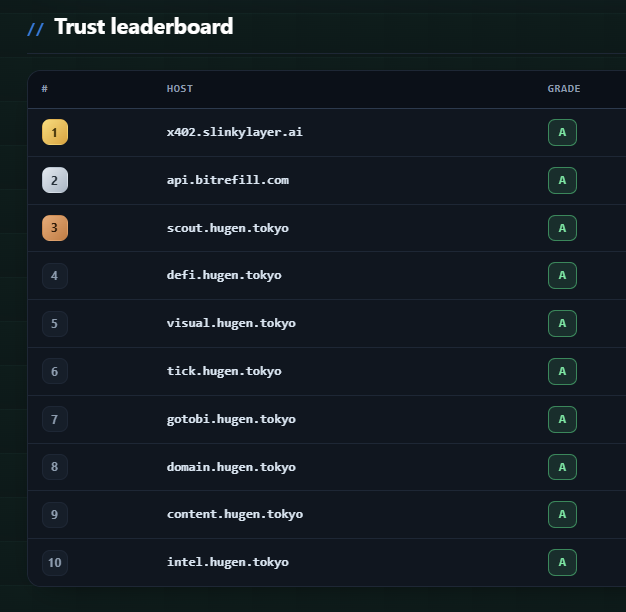
Free top-25 most trustworthy x402 endpoints, ranked by a deterministic trust score (uptime, envelope compliance, latency, age, on-chain settlement activity, price stability). Latency is measured from a single EU vantage point and includes network distance to the endpoint (so it is only lightly weighted). Use this to discover reliable paid endpoints.

FREE showcase of what x402_trust_score returns. You do NOT choose the endpoint: this returns the COMPLETE paid-grade trust report (every field — exact score, scoreRange, full component breakdown, advertised price, on-chain settlement figures, all flags) for THREE endpoints picked from the current population — the best-scored, the median, and the worst-scored ('samples' each carry 'role', 'populationRank', and the full 'report'). Use it to see exactly what the paid output looks like across the entire quality range BEFORE paying. It cannot score an endpoint you choose — to evaluate YOUR OWN endpoint, call x402_trust_score (paid). Takes no arguments.

Trust score (0-100, grade A-F, or '?' when unmeasured) for a SPECIFIC x402 endpoint -- cataloged or not (uncataloged endpoints are live-probed on first query, auto-adopted, score carries a low-confidence first-contact flag). PLUS a machine-readable verdict ('recommendation': proceed|caution|avoid|parameterize|unverified|not-payable), the advertised price ('advertised.amountUsd'), a confidence-adjusted band ('scoreRange'), and structured flags ('flagsDetailed' with code/severity/message; any severity 'error' means avoid). The 'parameterize' verdict (with 'templated':true) means the resource URL still contains an unresolved template placeholder (e.g. {slug}, :slug or %7B…%7D) but we DO have a real signal (scored probes or a discovery fallback): substitute a valid value first, then the health metrics apply to the resolved URL. The 'unverified' verdict (grade '?') means we have NO measurement at all (every probe excluded and no discovery payment requirements to fall back on): it is unknown, not bad, so verify the endpoint yourself before paying. The 'not-payable' verdict (grade '?') means the URL answers a 402 with an EMPTY accepts[] (an auth/API-key gate such as sign-in-with-x), so it is not an x402-payable resource at all and there is nothing to settle. For templated per-item endpoints that ARE payable, a varying payTo/price is EXPECTED (one wallet/price per item): the report surfaces 'stats.payToVaries'+'payToDistinct30d' and 'advertised.amountRange30d' as a 'payto-varies'/'price-varies' note rather than a 'payto-changed-recently' hijack error; always pay the payTo in the live 402 quote, not a cached listing. 'stats.scoredProbes30d' vs 'stats.excluded30d' show how many probes actually back the score. Includes the full component breakdown, the provider-advertised 'serviceName' and 'description' (unverified provider claims, shown next to our independent metrics), and 30-day on-chain stats. Note: 'stats.avgLatencyMs' is measured from a single EU vantage point and includes network distance to the endpoint (see 'stats.latencyVantage'), so a geographically distant endpoint reads slower even when its server is fast. One call answers WHETHER and at WHAT PRICE to use an endpoint. Call this BEFORE paying an unknown x402 endpoint to avoid dead, fraudulent, or recently-hijacked services. Pay-per-call over x402; auto-pays if a wallet is configured, otherwise returns the price quote.

Raw observation time-series for a SPECIFIC x402 endpoint: listing/delisting/relisting events, advertised price changes, payTo changes, and probe results (uptime, latency, quoted amount) over the requested window (1-90 days). Per-probe 'latencyMs' is measured from a single EU vantage point and includes network distance to the endpoint. Pay-per-call over x402; auto-pays if a wallet is configured, otherwise returns the price quote.

Given an x402 endpoint URL, returns the top semantically-similar endpoints (matched on advertised purpose via description embeddings) that currently OUT-SCORE it on the deterministic trust score. Use this to route away from a mediocre/dead/expensive endpoint toward a more reliable, better-settled one serving the SAME function — e.g. before paying, check if a higher-graded equivalent exists. Each alternative carries its trust 'score', 'grade', 'recommendation', cosine 'similarity' (0-1), 'amountUsd' price, and a free 'endpointPage' URL. Same-host siblings and 'avoid'-flagged endpoints are excluded. An empty 'alternatives' array is a valid answer meaning nothing beats the subject. Similarity is independent of latency/geography. Pay-per-call over x402 (~$0.005); auto-pays if a wallet is configured, otherwise returns the price quote.

Free-text SEMANTIC SEARCH across the entire monitored x402 endpoint catalog. Given a plain-language query (e.g. "weather forecast", "image generation", "EVM gas price oracle"), returns the up to 25 endpoints whose advertised purpose is semantically closest. Ranking is deterministic and fully specified: cosine similarity bucketed to whole percentage points first (80.3% and 80.5% are the same bucket, so sub-percent noise never outranks a better endpoint), then trust score (0-100), then described-before-undescribed, then endpoint id as a stable final tiebreak. Matches below a 0.5 cosine-similarity floor are dropped entirely, so a query can return fewer than the requested limit (or none). Endpoints that advertise no description are still matched: they are embedded from their service name and URL path tokens instead of a written description (host name as a last resort). The EXACT effect of a missing description: no fixed point deduction, and no direct similarity malus either; the only deterministic penalty is the described-before-undescribed tiebreak (at equal similarity bucket AND equal trust score, a described endpoint ranks first). Beyond that the effect is purely indirect: the shorter fallback text typically yields lower cosine similarity than a prose description, so undescribed endpoints tend to land in lower similarity buckets, by a query-dependent (never fixed) amount. Use this for DISCOVERY: find candidate endpoints for a capability before checking any of them in depth. Each match carries 'id', 'resource' URL, trust 'score' (0-100), 'grade' (A-F), raw cosine 'similarity' (0-1; ranking buckets it to whole percents), 'description' when advertised, and a free 'endpointPage' URL. 'score'/'grade' are null for endpoints not yet scored. Deliberately NO verdict/recommendation or flag detail: the per-endpoint trust report (x402_trust_score) carries those. Pay-per-call over x402 (~$0.001); auto-pays if a wallet is configured, otherwise returns the price quote.

Score up to 500 x402 endpoints in a SINGLE paid call. Returns the authoritative full-density trust score (0-100, grade A-F or '?' when unmeasured, recommendation proceed|caution|avoid|parameterize|unverified|not-payable), confidence, `probed_at`, `computed_at`, and a `recomputed` flag for each requested resource. Cache rows older than ~15 minutes are recomputed on-demand from the latest stored probes and settlements (no live network re-probe), so bulk scores typically reflect reality within minutes. Per-request recompute limits apply: at most 50 endpoints / 8 seconds are recomputed; the response includes `recompute_limit_hit` and `recompute_limit` so you know if the cap was reached. The smallest tier that fits your request is selected automatically (10/50/100/200/500 endpoints; ~$0.045/$0.20/$0.325/$0.40/$0.50). Resources not in our observation set return `found:false`; you still pay for the batch. For a fresh live probe, use `x402_trust_score`. Pay-per-call over x402; auto-pays if a wallet is configured, otherwise returns the price quote.

Start monitoring ONE x402 endpoint for 30 days. Get alerted on changes that break autonomous payment: payTo changes (possible takeover/rug — but for a templated per-item endpoint a payTo move is expected variance and is delivered as severity 'warn', not 'critical'), price changes, asset/network changes, 402-spec regressions, delisting, and liveness down/recovered. A self-healing endpoint that repeatedly blips is auto-detected as `liveness_flapping` and its individual down/up alerts are coalesced into a single flapping notice (plus one 'stopped flapping' notice when it stabilizes) so you are not spammed. Returns a one-time bearer secret + poll URL + renew URL + edit URL + cancel URL + machine-readable `next_steps`. Use x402_watch_events to poll the append-only log, or configure push delivery to one or more signed HTTPS webhooks and/or Slack/Discord incoming webhooks (max 5 each). `webhook_url`/`slack_url` accept a single URL string or an array of URLs. All URLs are connection-tested BEFORE payment — unreachable URLs are rejected with no charge (retry with a corrected URL). On success the response reports per-URL delivery in `delivery.connection_test`. Webhook signature: `x-signature` = 'sha256=' + HMAC-SHA256(body) keyed by hex(sha256(secret)), NOT the raw secret. Pay-per-call over x402 (~$0.20); auto-pays if a wallet is configured, otherwise returns the price quote.

Read the append-only event log for an active x402 watch. Returns two streams: `events` (endpoint changes — payTo/price/asset/spec/delisting/liveness) and `watch_events` (lifecycle feedback — created/edited/cancelled/renewed/expiring/expired). Nothing between two polls is lost. Provide the watch_id and the one-time secret from x402_watch_create. Advance `since` with the returned `next_cursor` (endpoint events) and `watch_since` with `watch_events_cursor` (lifecycle events). Cursors/ids are GLOBAL sequences shared across watches (a watch's first event id may be >1); always page by the returned cursor rather than assuming they start at 1. Cancelled watches remain READABLE until expires_at (no new events accrue). If the watch has push delivery, still poll to reconcile missed webhooks.

Edit an active watch: change webhook/Slack URLs, liveness sensitivity, or subscribed events. Bearer-authed with the secret from x402_watch_create. Newly-added URLs are connection-tested before the change is persisted; if any new URL fails, the existing config is unchanged. Delivery fields are full-replace per channel (omit to leave that channel unchanged). Returns the updated watch view.

Soft-cancel a watch immediately: no new events accrue, but the event log stays READABLE via x402_watch_events until the original expires_at (cancel is not a delete). Probing drops back to normal cadence as soon as no active watches cover the endpoint. Bearer-authed with the secret from x402_watch_create. Free and idempotent.

Extend an active x402 watch by another 30 days before it expires. The secret stays the same. Pay-per-call over x402 (~$0.20); auto-pays if a wallet is configured, otherwise returns the price quote.

概览

What is x402 Trust?

x402 Trust is an MCP server backed by a continuously running monitor (https://x402-trust.com) that probes every publicly listed x402 endpoint around the clock and scores each one from 0-100 (graded A-F) using real signals: 30-day uptime, 402-envelope spec compliance, latency, observed age, price stability, and actual on-chain USDC settlement volume.

The result is an auditable, deterministic trust score that catches what uptime-only checkers and raw explorers miss.

How to use x402 Trust?

Two ways in: zero-install via the hosted endpoint (POST https://x402-trust.com/mcp), or locally with npx -y x402-trust-mcp. 8 of the 15 tools are free and work out of the box: ecosystem stats, the provider leaderboard, keyword catalog search, the verified-provider list, full sample trust reports, and watch event polling. Paid tools (per-endpoint trust scores, observation history, semantic search, alternatives, bulk scoring, 30-day watches) settle per call over x402; with a funded Base USDC wallet in X402_PRIVATE_KEY the server auto-pays within your configured caps.

Key features of x402 Trust

  • Deterministic, fully auditable scores from uptime, compliance, latency, age, price stability, and on-chain settlement volume.
  • A live re-probe at purchase time: "up" means right now, not historically.
  • Machine-readable verdicts (proceed / caution / avoid / parameterize / unverified / not-payable / free) plus structured flags with severities.
  • Discovery both ways: semantic search by capability and free keyword search by host, URL, or service name.
  • Provider verification with published contact profiles, surfaced as providerVerified/providerName marks across all listing tools.
  • 30-day endpoint watches with push alerts (webhooks, Slack, Discord) on payTo, price, spec, and liveness changes.
  • Responses are signed (JCS + SHA-256 + Ed25519), so results can be frozen and verified as evidence.

Use cases of x402 Trust

  • Find every endpoint of a provider by domain, or discover new capabilities by meaning.
  • Check the trust score and verdict of an x402 endpoint before paying it.
  • Route away from a mediocre endpoint toward a better-scored equivalent serving a similar function.
  • Detect dead endpoints, shared payTo wallets that obscure settlement volume, uncollectible Solana payout addresses, and recently changed payTo addresses.
  • Monitor partner endpoints for 30 days and get paged on the changes that break autonomous payment.

常见问题

1

What signals does the trust score use?

The score blends 30-day uptime, 402-envelope spec compliance, latency, observed age, advertised-price stability, and real on-chain USDC settlement volume to the endpoint's payTo address, with a confidence value and a score band on top.


2

Is there a free tier?

Yes, and it is generous: 8 of the 15 tools are free, including ecosystem stats, the top-100 provider leaderboard (paged), keyword catalog search, the verified-provider list, and three complete sample trust reports (best, median, worst) that show the exact paid data shape.

3

How much do paid calls cost?

Semantic search $0.001, a trust score or alternatives lookup $0.005, raw observation history $0.02, a 30-day watch about $0.20, and bulk scoring $0.045 to $0.50 for up to 500 endpoints. Pay-per-call over x402 in USDC on Base; auto-pay kicks in when a wallet is configured.

4

Where can I browse the data without the MCP?

On https://x402-trust.com: searchable catalog, per-endpoint pages, provider directory, facilitator leaderboard, badges and share cards, plus the free JSON endpoints the MCP tools wrap.

5

What does the live probe do?

Paid trust calls re-probe the endpoint live at decision time, so an "up" reading means reachable right now. Uncataloged endpoints are live-probed on first query and adopted into the catalog automatically.

评论

搜索 分类下的更多 MCP 服务器