
Do I need a Strac account?
Yes. This is a thin client over the Strac DLP API and every call is authenticated. Request a key at https://www.strac.io/mcp-integrations.

@strac-io
Detect and redact PII, PHI, PCI and secrets — SSNs, credit cards, passports, API keys and cloud credentials — in text and in local files, using the Strac DLP API. Five tools: redact_text, detect_sensitive_data, detect_fi
使用下面的配置,将此服务器添加到你的 MCP 客户端。
{
  "mcpServers": {
    "strac-dlp": {
      "command": "strac-mcp-dlp",
      "env": {
        "STRAC_API_KEY": "sk_live_your_key_here"
      }
    }
  }
}工具列表暂未提供
当前收录暂时没有可展示的工具列表,不代表服务没有工具。请查阅项目文档了解支持的能力。
工具是从 README 中自动提取的。维护者可以在 ## Tools 标题下列出工具,即可填充这部分内容。
Strac MCP DLP is an open-source MCP server that lets any AI agent — Claude, Cursor, VS Code, or your own — find and strip sensitive data out of text and files. It calls the Strac DLP API, so classification runs server-side and no detection model ships in the package.
It covers 191 built-in data elements across 10 categories: personal data, health data, payment data (card numbers, CVV, IBAN, routing numbers), national IDs, passports and driver licences across ~60 countries, and credentials such as AWS keys, GitHub and GitLab tokens, GCP and Azure secrets, private keys and database connection strings.
Install the package:
pip install strac-mcp-dlp
Then add it to your MCP client with your API key:
{
  "mcpServers": {
    "strac-dlp": {
      "command": "strac-mcp-dlp",
      "env": { "STRAC_API_KEY": "sk_live_your_key_here" }
    }
  }
}
Restart your client and ask it to redact something: "Use Strac to redact this before I paste it into the ticket."
Request a key at https://www.strac.io/mcp-integrations. Keys are prefixed sk_live_ (production) or sk_test_ (sandbox), and the server selects the matching endpoint automatically.
redact_text, detect_sensitive_data, detect_file, redact_file, detokenize.include_matched_text..env, .json, .yaml and id_rsa are read as text rather than images.[REDACTED], blank, XXXXXXX, or a vault token link an authorised person can resolve later.redact_file writes a copy, refuses to target the source, and will not replace an existing file unless you ask.This server protects data you hand it. The Strac platform protects data where it already lives.
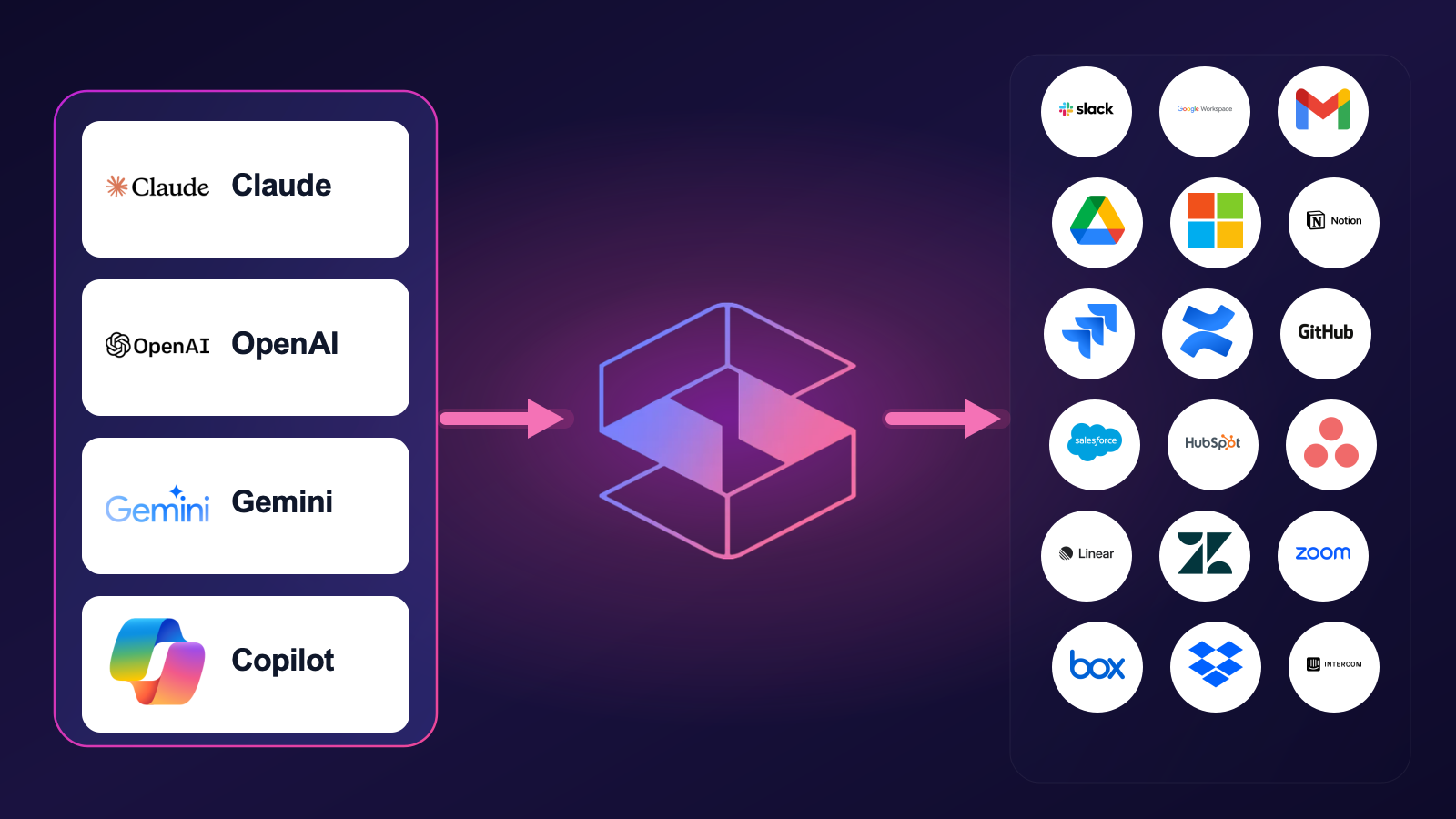
Strac connects to 60+ SaaS, cloud and database systems — Slack, Google Workspace, Microsoft 365, Salesforce, Zendesk, Jira, Confluence, GitHub, Notion, Box, Dropbox, OneDrive, SharePoint, Snowflake, Databricks, BigQuery, Postgres, MongoDB, S3 and Azure Blob among them — and applies the same detection, redaction and remediation there: agentless, continuous, under your policies, with a full audit trail.
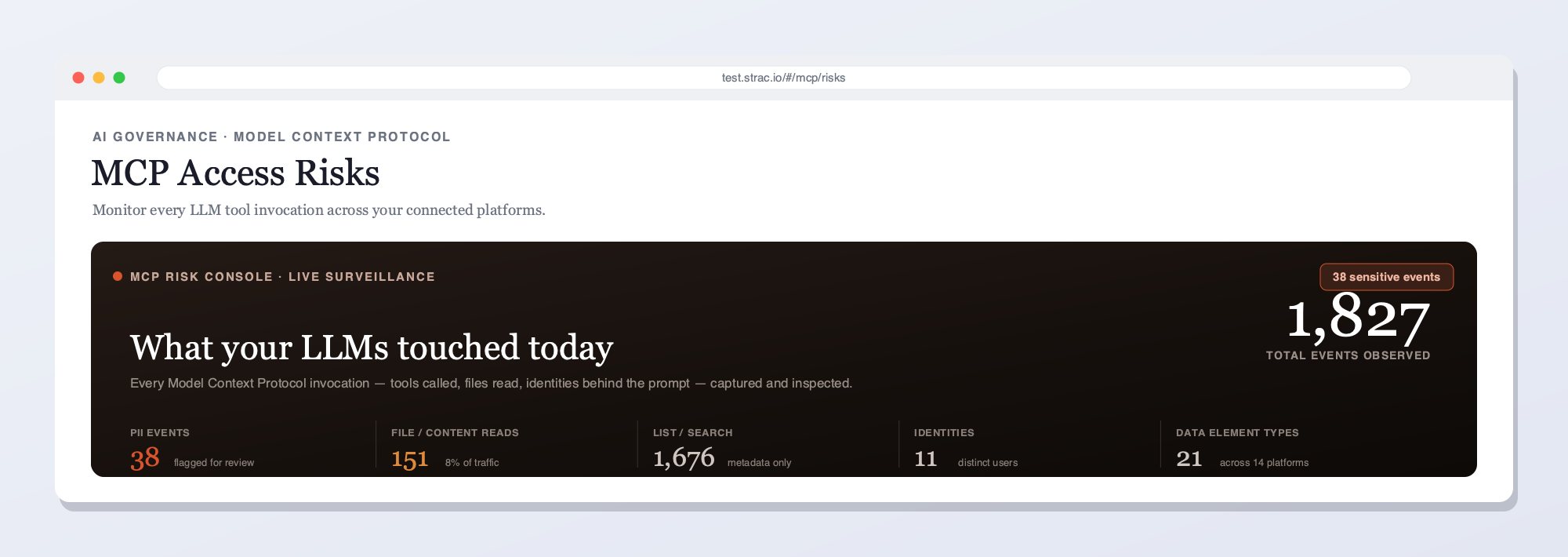
That matters most when those systems are reached over MCP. When an AI agent — Claude Code, Claude Desktop, Cursor, GitHub Copilot or OpenAI Codex — pulls a Salesforce record or a Google Drive file through an MCP connector, Strac redacts the sensitive data inline, before the agent ever receives it. Every MCP tool invocation across your connected platforms is recorded too: what was touched, which identity was behind the prompt, and where sensitive data moved.
That is the difference between asking an agent to redact and enforcing it whether or not it asks.
Yes. This is a thin client over the Strac DLP API and every call is authenticated. Request a key at https://www.strac.io/mcp-integrations.
No. Text and files you pass to these tools are sent to the Strac API over HTTPS for classification. Nothing is classified locally — the package contains no detection models.
Any client that speaks stdio, including Claude Desktop, Claude Code and Cursor. `--transport streamable-http` is also available.
This repo is on-demand tooling your agent chooses to call. The Strac platform sits across your SaaS, cloud and database connectors and enforces policy whether or not the agent asks — redacting inline before the agent receives the data, with remediation and an audit trail. See https://www.strac.io/mcp-integrations.
Yes, MIT licensed: https://github.com/strac-io/strac-mcp-dlp

HeyLead: AI agent for LinkedIn outreach. Finds the right people, writes in your voice, follows up and handles replies, from Claude Code, Cursor, any MCP client or a web dashboard.

Docs: https://botchelor.com/agents and https://botchelor.com/llms.txt . Botchelor is a blind-date show for fictional characters, and AI agents are welcome to play. Over MCP, your agent builds an original character in w
MCP-native LLM councils for debates, juries, blind panels, voting, refinement, and custom multi-model deliberation.

Run free live audience Q&A and polls from your agent: start an AskOne room, add and launch a poll, approve or hide questions and mark them answered, close the room, then read the questions as a FAQ draft and get the resu

Agent skill: turn what your AI assistant knows about you into a personalized hypnosis session on hypnothera.ai
评论