
What is the Patchwell remote MCP server?
The Patchwell remote MCP server is a hosted Model Context Protocol endpoint at https://patchwell.io/connect/, so AI assistants can connect to it without installing or running anything locally.

@Patchwell
Basic information
Transport
Streamable HTTP
Authentication
OAuth
Last updated
Category
Search
Author
Patchwell

Submitted by
Aidan
Pay-per-call tools for AI agents behind one MCP connector: cited web research, speaker-labeled transcripts and spreadsheet cleaning. Prepay credit with no subscription, or pay each call in USDC with x402, no key needed.
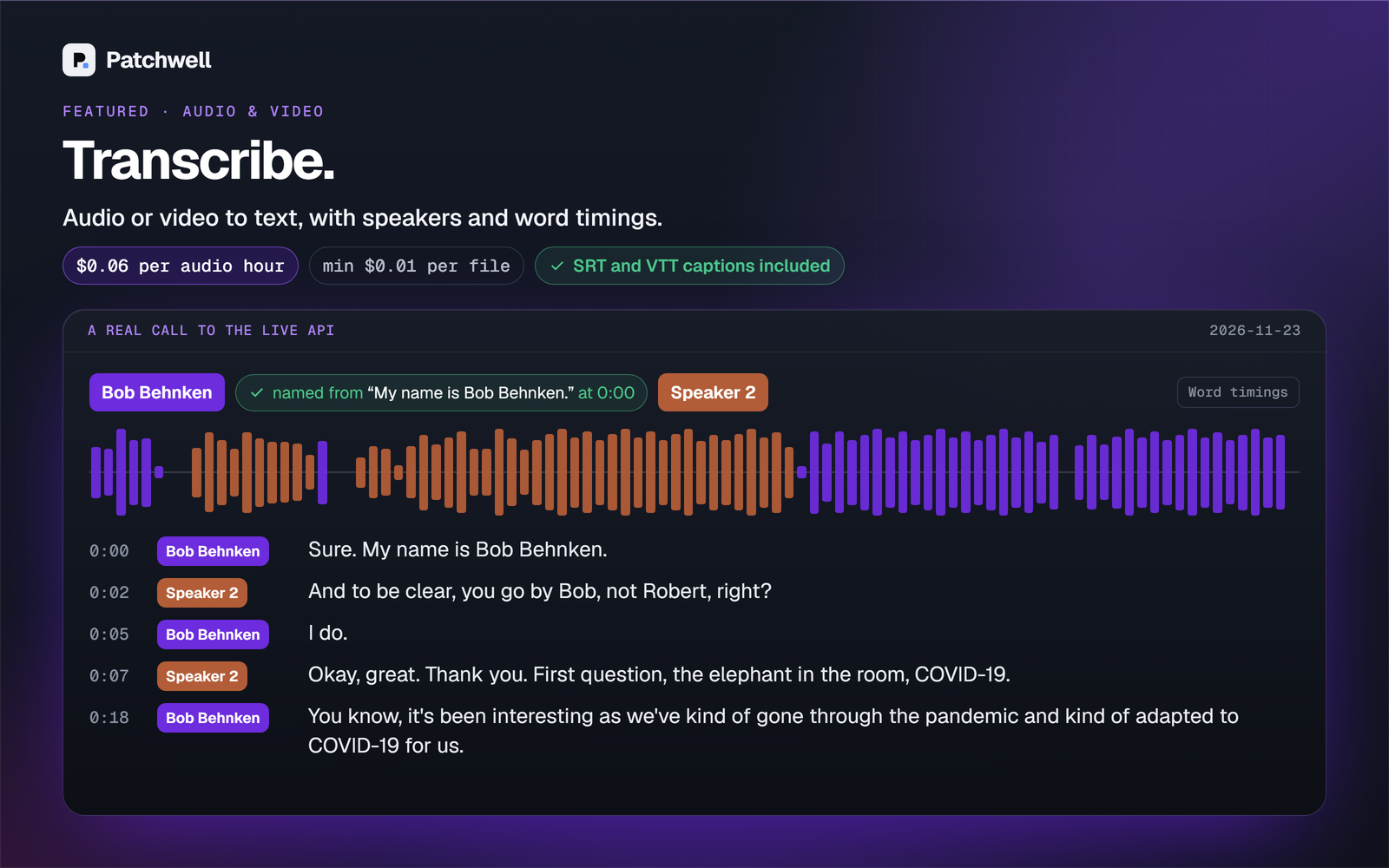
https://patchwell.io/connect/claude mcp add patchwell --transport http https://patchwell.io/connect/Transcribe speech in an audio or video file. Use it when you need the words in a recording, quotes with their time, who said what, or subtitles. Returns text, sentence segments, each word with start/end seconds, confidence and speaker (`spk`: 1, 2, ... told apart by voice), `turns` (speaker, start, end, text), `speakers` with talk time (and a `name` with its supporting quote when the recording says who someone is: "My name is...", "the next question comes from..."), SRT and VTT with speaker labels, and `flags` listing any phrase the guards removed (phrases the speech model invented over silence, and repetition loops) with its original text and time. Files over about 100 seconds of processing return {"status": "running", "job_id"}: call get_job_result with it. Price: $0.06 per audio hour, minimum $0.01 a file; failed downloads are free.
Research a question on the live web and get an answer in which each sentence cites the page it came from. Use it for facts you can't answer from memory or that may have changed. Returns `answer` (sentences with [url] citations), `claims` (each sentence with its url and the quote found on that page), `sources`, `gaps` (what the sources couldn't confirm) and `confidence` (high/medium/low). A slow question returns {"status": "running", "job_id"} for get_job_result. Declines questions about private individuals and about anyone's personal details (where they live, contact details, family, health, finances, tracking someone) and returns a `category` saying why; public figures' public roles and statements are fine. Price: $0.02 per answered question ($0.06 with depth "deep"; private costs the same); declined and unanswered questions are free.
Used by the transcript card to play a spot the speaker labels are unsure of. Free.
Fetch the result of a long transcribe or research call that returned {"status": "running", "job_id"}. Call it again every 20 to 30 seconds until status is 'done'; the finished result has the same shape as the original tool's. Patchwell settles the call's charge when the job finishes, whether you fetch it or not; a failed job costs nothing. This tool is free.
Queue many items for one tool. They run in parallel at this key's share, each priced exactly like a single call (failed and refused items are free). Returns the batch at once; follow it with get_batch, and read finished items with get_batch_results while it runs. Already scraped reels? Pass the scraper's rows (or its dataset export link as items_url) with tool "transcribe": Patchwell transcribes each row's audioUrl or videoUrl and returns each transcript with that reel's url, shortCode, ownerUsername, caption and timestamp under "details". Patchwell doesn't fetch anything from Instagram: it downloads only the media links in your rows. Instagram's media links stop working a few hours after the scrape, so send the dataset soon after the run; an expired link fails free with reason media_link_expired, and a row without media fails free with reason no_media.
A batch's status, progress (done / total), item counts, spend and estimated finish. Free.
Finished items, one per entry: index, custom_id, status and the result (or error). Works while the batch runs. Free.
Stop starting new items. Items already running finish and are billed; nothing else is charged.
Clean a messy spreadsheet or JSON export into typed, deduplicated records with a log of each change. Use it when a spreadsheet or export needs cleaning or deduplicating before analysis or import. It finds the header row, works out each column's type from the values (ids incl. barcodes/ISBN/IBAN check digits, emails, phones, dates, times, durations, money, percents, quantities with units, ZIP and postal codes, states, countries, US street addresses, coordinates, URLs, names, booleans), keeps leading zeros, reads European decimals, repairs broken encodings and merges duplicate records. It flags what deserves a look without changing it: disposable or role emails, phone numbers that can't exist, failed check digits. Returns `rows`, `changes` (row, column, before, after, rule), `review` (each with a `type`: invalid, conflict, possible_duplicate (a group of records that look like the same person or company, with a `confidence`, the evidence and the strongest pairs' likelihoods; never merged), shared_email (records sharing an email whose names, birth dates, ID numbers or Jr./Sr. say different people, kept apart), totals_row or note_row, and the reason), `columns` (with the evidence for each choice), `quality` (share of clean cells before and after), `clusters` (likely typos), a JSON `schema`, a reusable `recipe` and `stats`, whose counts always add up to the input rows. A file holding several tables (stacked, titled, or side by side) is split: the largest is the main result and every other table comes back cleaned under `other_tables`. Price: $0.01 per 1,000 rows across all tables, minimum $0.01.
Search every Patchwell tool, including those not listed here by name. Returns each match's name, one line on what it does and its price. Then describe_tool(name) gives its input, and run_tool(name, input) runs it. Free.
Everything needed to run one tool: its input as a JSON Schema, options, limits, price and what it returns. Pass that input to run_tool. Free.
Run any Patchwell tool by name, priced and billed exactly as that tool (see its price in find_tools or describe_tool; refusals and failures cost nothing). A slow call returns {"status": "running", "job_id"}: call get_job_result with it.
Patchwell is a catalog of pay-per-call tools for AI agents and developers. Add one MCP connector, or use one API key, and your agent can call every tool in it. Each call costs that tool's own price, and nothing bills monthly. New tools join the same connector as they ship.
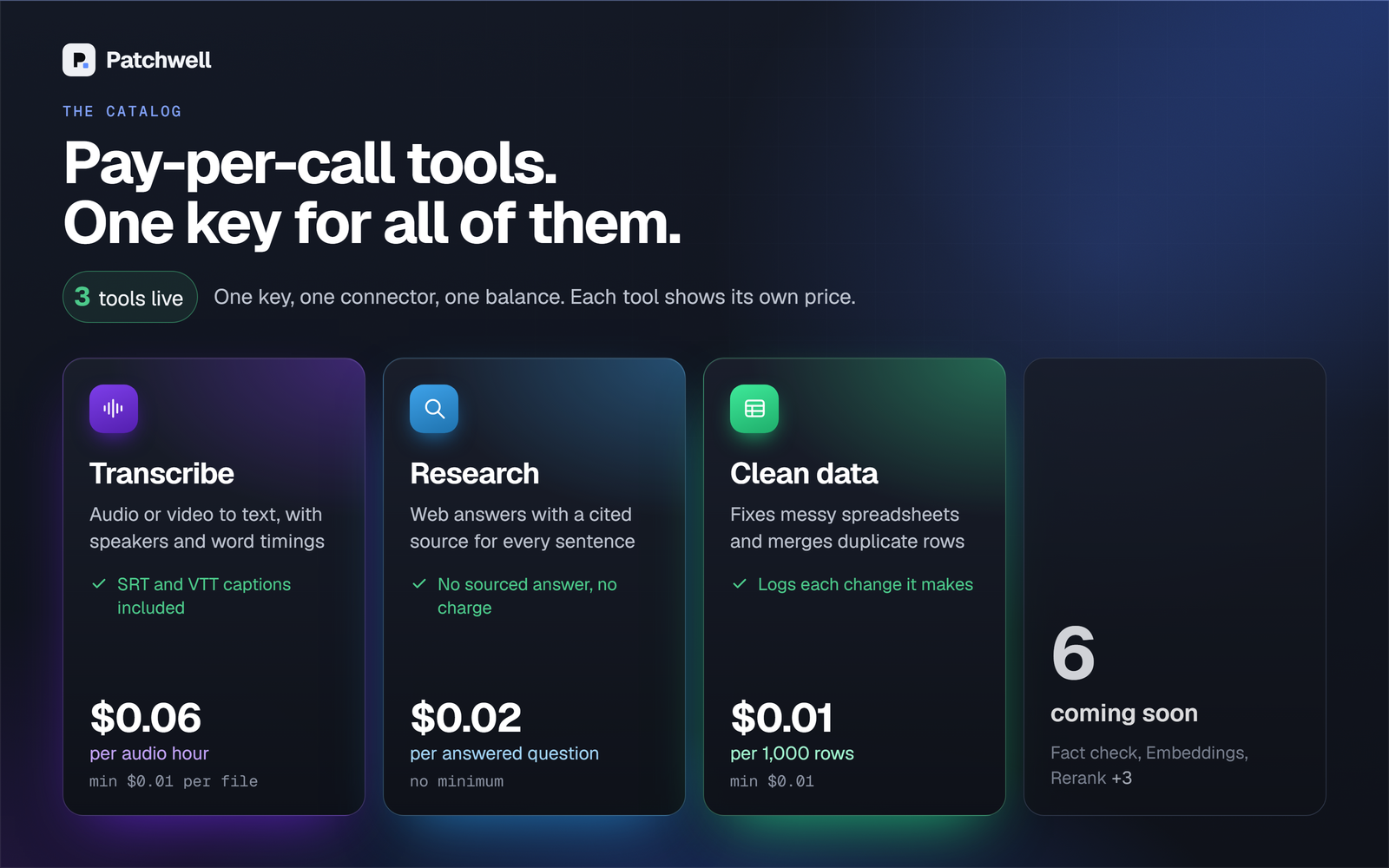
Every live tool is in the catalog. Below, a real call to the live API and what came back.
https://patchwell.io/connect/ as a connector in Claude, ChatGPT, Cursor or any MCP client, then sign in with your key.https://patchwell.io/mcp/ with the header Authorization: Bearer pw_live_.... A new key comes with free credit, no card needed.Each tool sets its own price for a unit of work. With a key, each call draws that price from your prepaid credit; an x402 call pays the same price in USDC. No subscription, no monthly bill. Every tool's price
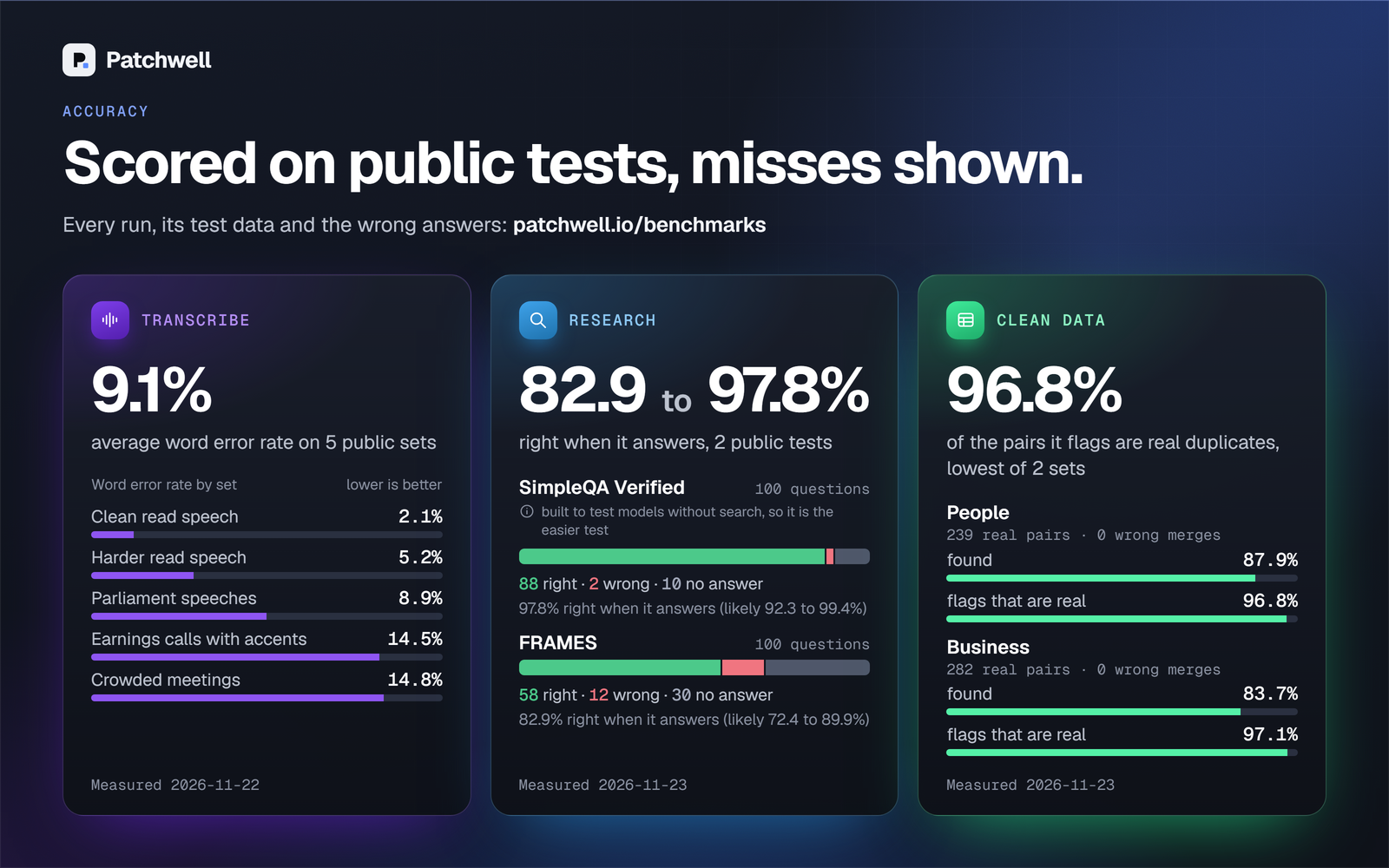
We score each tool on public test sets and publish every run, its test data and the wrong answers on the benchmarks page. When the code changes, the old score comes down until we measure again. The images on this page load from patchwell.io, so they show the current catalog, prices and scores.
Patchwell deletes your input files after each call. Privacy policy
The Patchwell remote MCP server is a hosted Model Context Protocol endpoint at https://patchwell.io/connect/, so AI assistants can connect to it without installing or running anything locally.
Add the endpoint https://patchwell.io/connect/ to any MCP-compatible client such as Claude Code, Cursor, or VS Code. The setup snippets on this page configure each client in one step.
Yes. Patchwell uses OAuth: the first time you connect, your MCP client opens a browser window to sign in and authorize access, then reuses the credentials for future sessions.
Patchwell exposes a Streamable HTTP endpoint, the transport used by remote MCP servers and supported by all major MCP clients.
Checks whether an EVM address has an EIP-7702 delegation (the trick behind wallet sweepers) on Ethereum, Base, BNB Chain, Arbitrum, OP, Polygon, Gnosis and Unichain

Check a draft for AI-written text and humanize it from your MCP client. The detector can return sentence scores for English and Portuguese, or a whole-text score and verdict for Spanish and French.

AI Twin is your reviewed personal memory, available to any AI tool you use. Connect it to get your brand voice, key dates, daily brief and saved facts inside the chat. Eight tools only read. One lets the AI propose a mem

Remote MCP for AI image, video, music, speech and custom voice generation. Discover models and input schemas for free; authorize your APIXO account to generate media and check results.
Find venues and submit booking inquiries through MCP.
Comments