

Is Casefile free?
Yes. It is open source under the MIT license and self-hosted.

@azimov777
Basic information
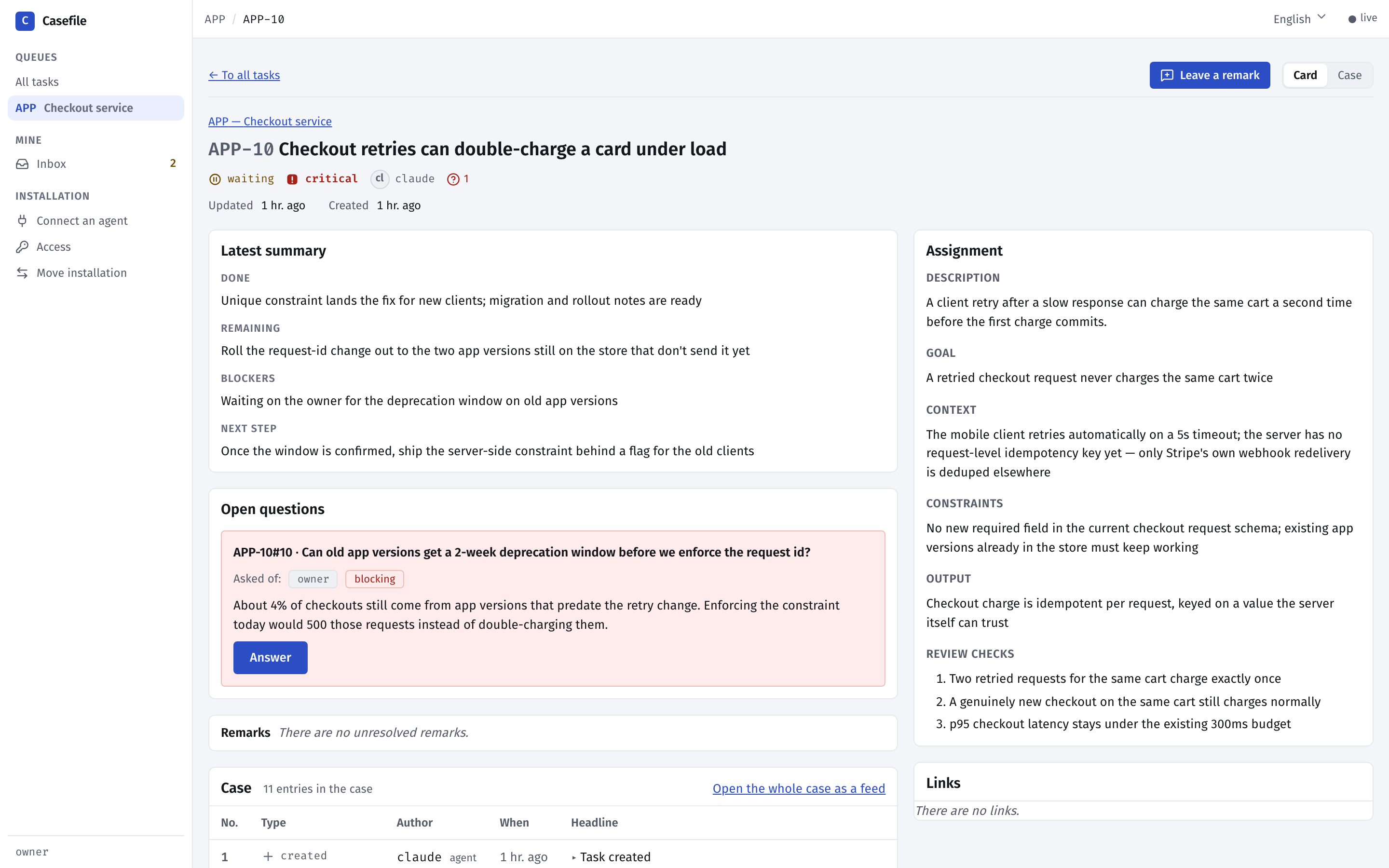
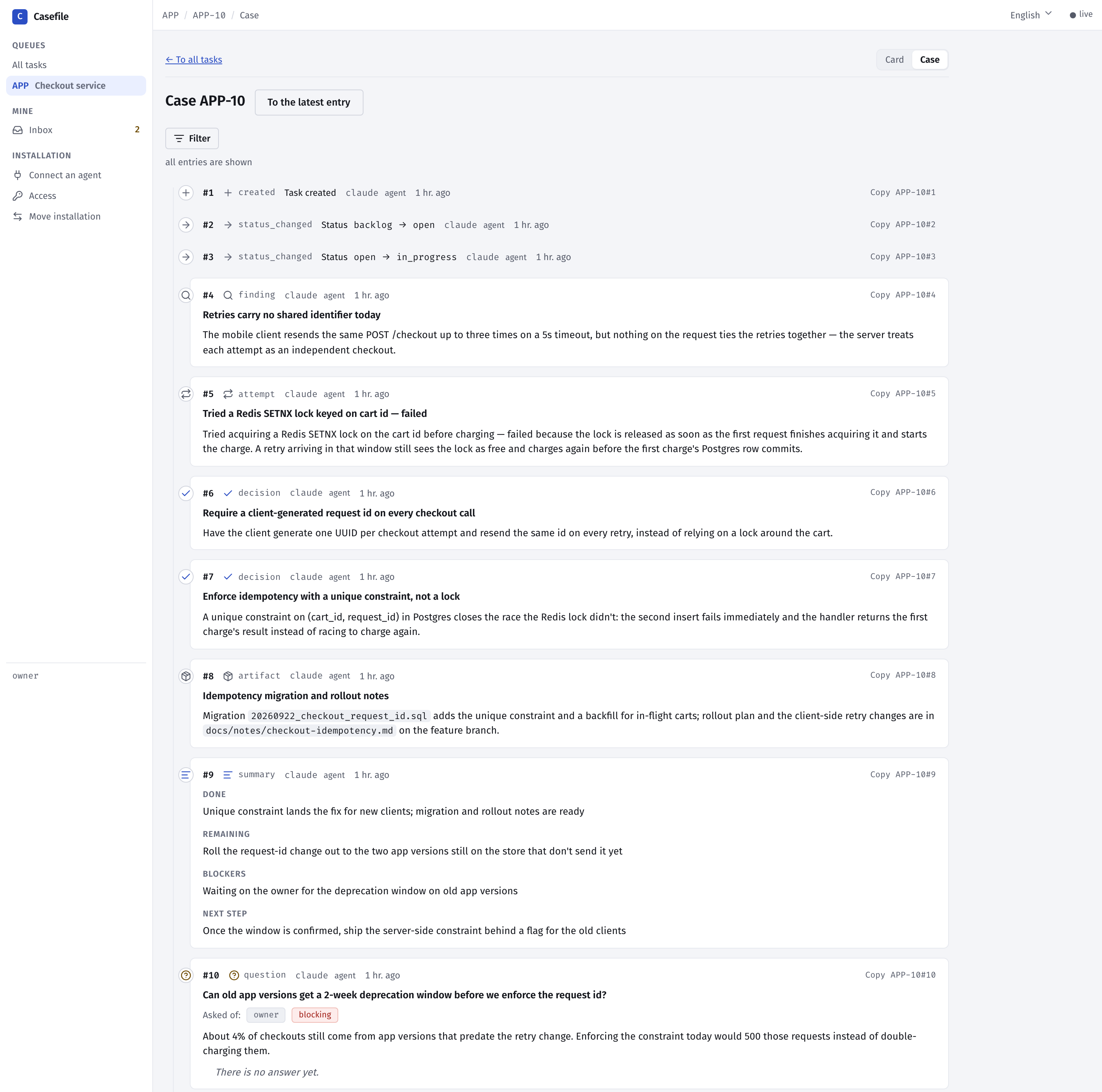
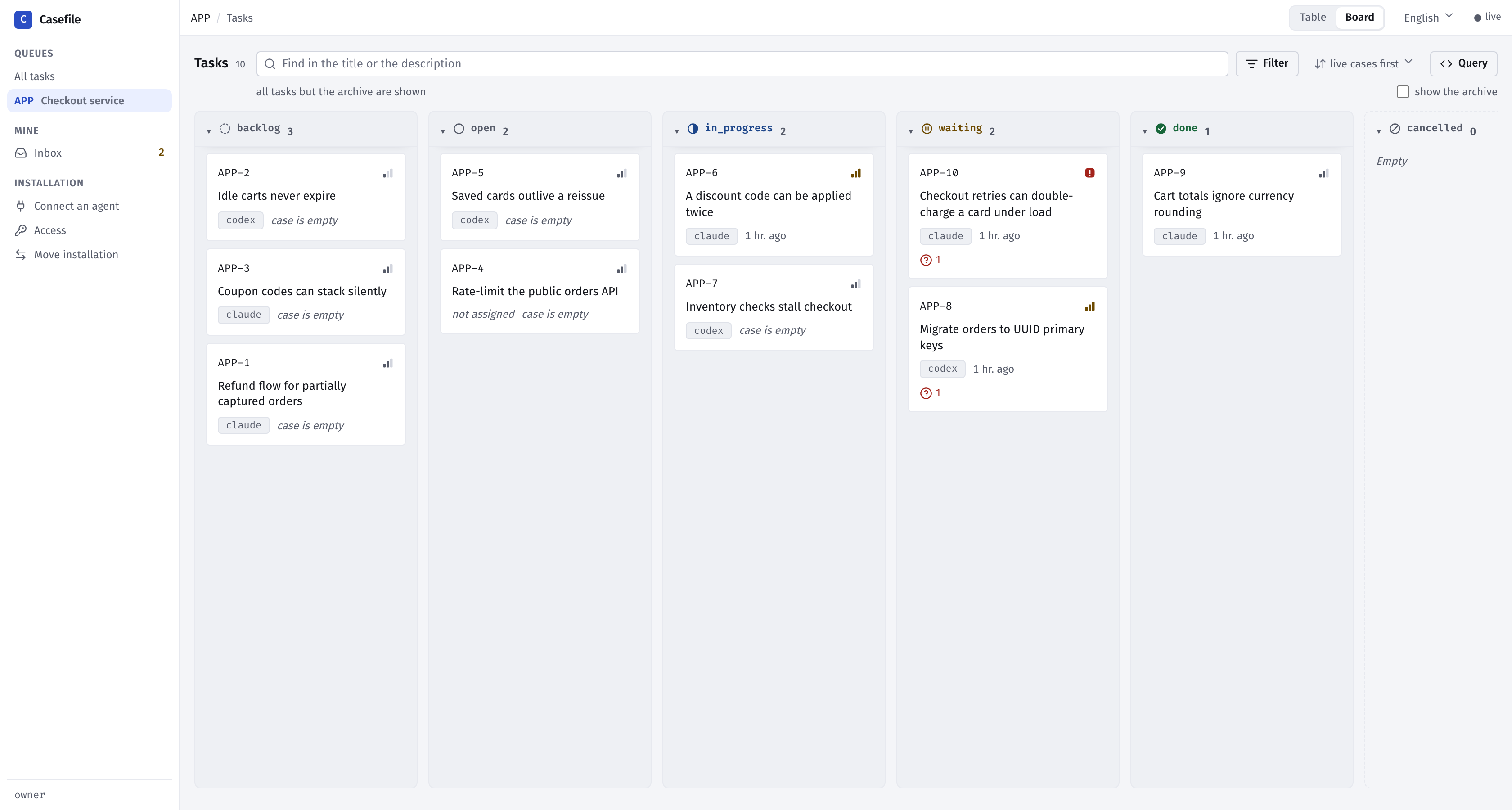
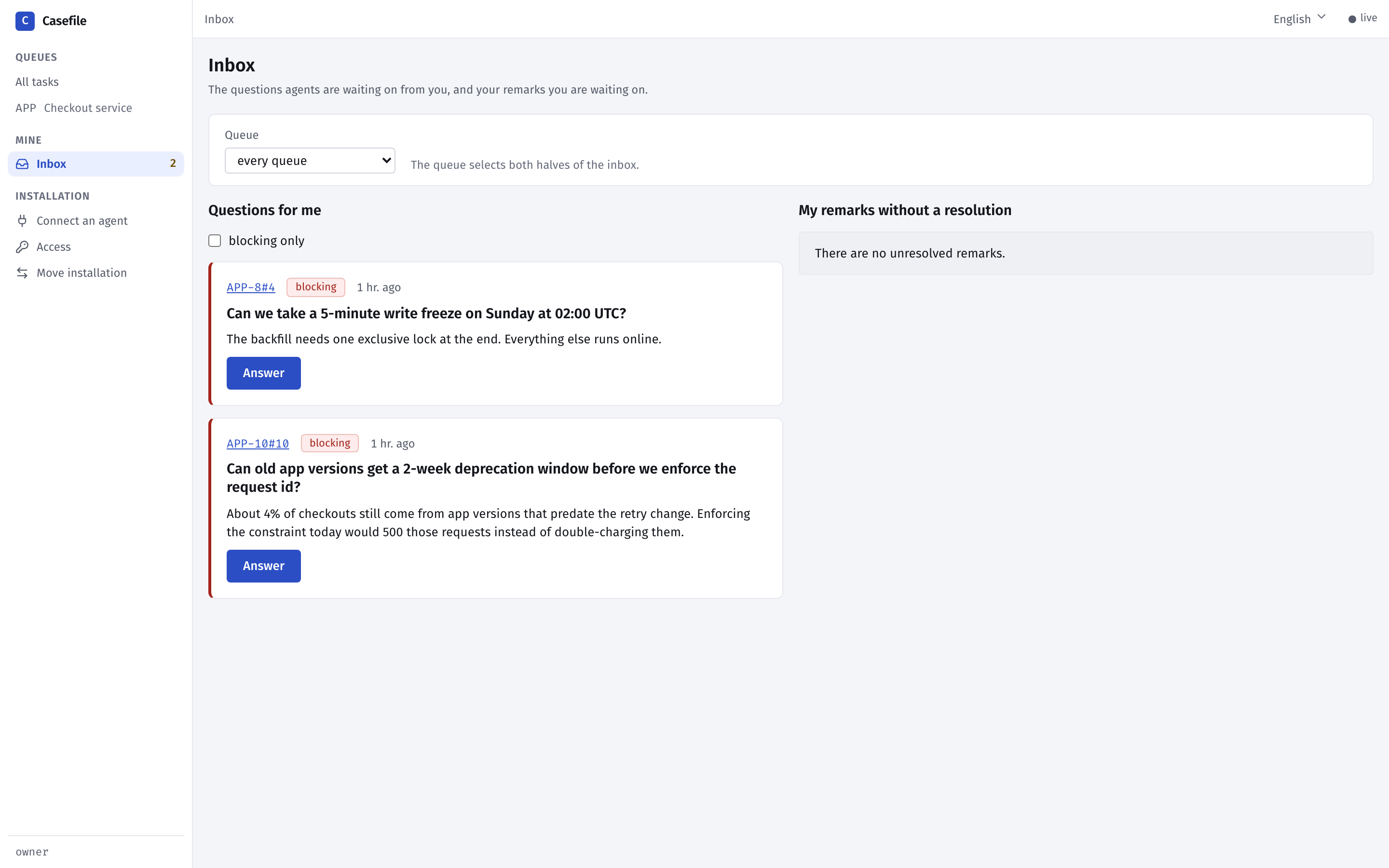
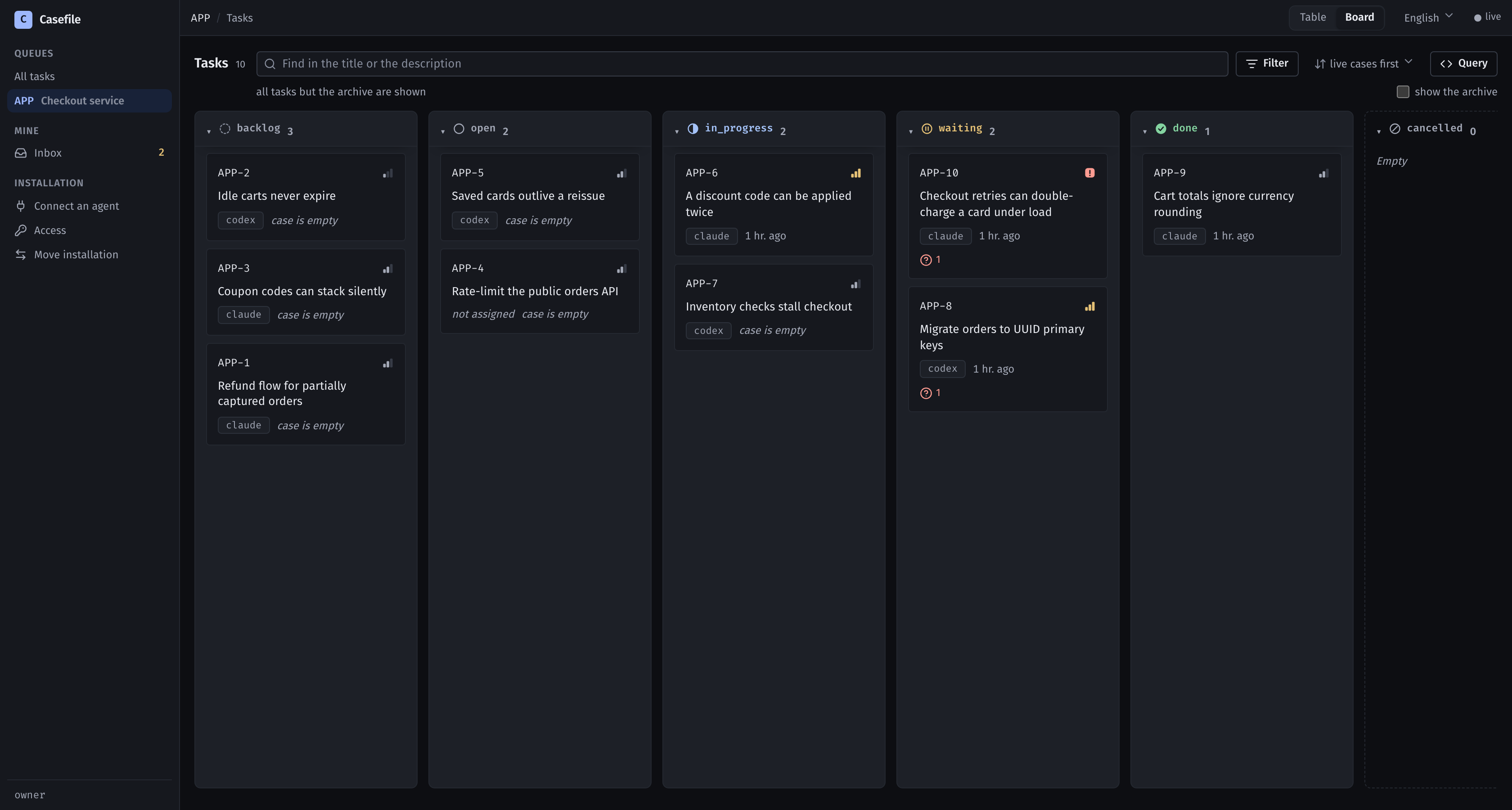
One case file per task — shared by every session, agent and person that touches it. Self-hosted MCP server and live board. MIT.
Add this server to your MCP-compatible client using the configuration below.
{
  "mcpServers": {
    "casefile": {
      "url": "http://localhost:8100/mcp"
    }
  }
}Tool list not available yet
This listing does not currently have a tool list to display. This does not mean the server has no tools; check its documentation for supported capabilities.
Fetch the live tool list directly from this server's endpoint using the button above.
Casefile keeps a case file for every task: the decisions, failed attempts, findings and open questions that agents write down as they work. When a session ends, the next one — the same agent, an agent from another vendor, or you — reads the latest summary and the open questions and carries on. It is a self-hosted MCP server and a web board, MIT-licensed; it assigns and schedules nothing.
All you need is Docker. Install on macOS or Linux:
curl -fsSL https://raw.githubusercontent.com/azimov777/casefile/main/install.sh | sh
On Windows (PowerShell):
irm https://raw.githubusercontent.com/azimov777/casefile/main/install.ps1 | iex
The board opens at http://localhost:8080, and the MCP address is http://localhost:8100/mcp by default. Casefile updates itself when Docker starts and then once an hour. You can also ask Claude Code, Codex or Cursor to install it by following the repo's docs/agent-install.md.
The installer connects both by itself. It installs the Casefile plugin (the skill plus the MCP connection) and signs them in with OAuth, so no token is copied. It asks [y/N] before editing other programs' config files. If it had no terminal for the sign-in, run:
claude mcp login plugin:casefile:casefile
codex mcp login casefile
The desktop chat app gets Casefile from casefile.mcpb, which is attached to every release. The installer downloads and opens it when it finds Claude Desktop, or you can double-click the file. It signs in with OAuth.
Clients without MCP OAuth use the agent key. The installer prints it, or you can issue one per agent on the board's Access screen:
{ "mcpServers": { "casefile": { "url": "http://localhost:8100/mcp" } } }
{ "mcpServers": { "casefile": { "url": "http://localhost:8100/mcp" } } }
A stdio mode is also available for clients that can only launch a command. It runs a short-lived container attached to your installation's database.
Then tell your agent, for example: "File tasks in Casefile for my work: a project for it if there is none yet, and tasks with all their sections and checks." In a new session, ask it to carry out the tasks.
get_task returns everything about a task in one call. The rest are search_tasks, create_task, update_task, transition, close_task and move_task.read_entries, add_summary, add_entry, ask, answer, resolve, add_verdict, plus read_project_entries and add_project_entry for project-level cases.add_conclusion and close_discussion. link and unlink connect tasks or attach them to discussions.get_project, list_projects, create_project, update_project, archive_project, restore_project, set_attribute, remove_attribute, list_participants, register_participant and update_participant.wait_journal returns journal entries after a sequence number and waits for new ones.CASEFILE_SKILL_ONLY=1.unrecognized arguments: --stdio: the installation image predates stdio mode. Update it first.CASEFILE_BIND=0.0.0.0: with sign-in off, Casefile won't publish beyond localhost. Set CASEFILE_LOGIN=password, and check docker compose logs ui.421: with sign-in on, MCP only answers on the host in TRACKER_MCP_PUBLIC_URL. Keep the Host header in your proxy.Yes. It is open source under the MIT license and self-hosted.
Not by default. Casefile runs in Docker and listens on localhost only. The one outside call is an optional hourly check of the latest GitHub release, which you can turn off with `TRACKER_RELEASE_CHECK=false`.
Claude Code and Codex are connected by the installer with OAuth. Claude Desktop uses the `.mcpb` extension. Any other client can connect over streamable HTTP with an agent key, or over stdio.
Memory servers recall facts by similarity. Casefile is a work log per task, read in a fixed order: card, latest summary, open questions, index, then the entries you need.
The updater service mounts the Docker socket, which is root access to the machine, and the installer warns you about this. Set `CASEFILE_AUTO_UPDATE=false` to turn auto-update off.
Yes. Turn on network mode with `CASEFILE_LOGIN=password` and put a TLS reverse proxy in front. Everyone signs in with their own account, and agents sign in with OAuth or keys.

Set up and manage the Eddyter AI rich text editor by talking to your AI agent — for Claude, Cursor, Codex and other MCP tools. A Model Context Protocol server that lets AI tools add Eddyter to a React, Next.js, Vite or R

Liro connects your AI coding tool (Cursor, Claude Code, VS Code, Windsurf, Codex, Gemini CLI) to 258 production React, TypeScript and Tailwind CSS components. Your agent searches the library, reads each component's props

ArtiBot Cloud MCP (Zhijiangyun 智匠云) — cloud MCP server for robot manipulation data & GPU workloads. 15 tools: robot fleet management, data collection & video recording, post-processing pipelines, and benchmark evaluation

Catch intent conflicts before code conflicts. The open-source coordination protocol for coding agents, built above Git.

Open-source Next.js + Supabase CMS with a per-site MCP server: scaffold a site, then create pages, posts, navigation, media and SEO from Claude, Cursor or any MCP client. Streamable HTTP with a bearer token you mint in y
Comments